
 Brian Fairchild
Introduction
Brain and blood pressure have always been connected. Your doctor knows it, researchers know it, and most of us sense it on some level. Stress tightens your chest. A shock sends your pulse racing. Anxiety makes your head pound.
But the connection runs deeper than emotion. A 2026 study in Circulation Research found a specific brain region that may directly drive high blood pressure. It does this in a large share of people who have it.
What makes this finding especially relevant is what it reveals about breathing. The way you exhale may be fueling, or calming, your blood pressure every single day.
The Discovery: A Brain Region Scientists Did Not Expect to Find
Researchers at the University of Auckland and the University of São Paulo were studying a small cluster of neurons deep in the brainstem. The brainstem handles automatic functions like heart rate, digestion, and breathing. It does this without any conscious input from you.
The region they focused on is called the lateral parafacial region. Under normal conditions, it has one job: driving forced exhalation. That is the kind of exhale you produce when you cough, laugh hard, sneeze, or push through a tough workout.
Those exhalations are not passive. They require your abdominal muscles to contract hard and push air out. A normal exhale, by contrast, simply happens. Your lungs are elastic. They recoil and air leaves without any muscle effort.
“The lateral parafacial region is recruited into action causing us to exhale during a laugh, exercise or coughing. These exhalations are what we call ‘forced’ and driven by our powerful abdominal muscles.” — Professor Julian Paton, University of Auckland
Here is where the research gets surprising. This same brain region also connects to sympathetic nerves that tighten blood vessels. When those nerves fire, blood vessels constrict and blood pressure rises. When the lateral parafacial region stays overactive, it keeps those nerves running hotter than they should.
The team tested this directly in animal models using precise genetic techniques. The results were clear. Activating the lateral parafacial region raised blood pressure. Inhibiting it brought blood pressure back to normal.
“We’ve unearthed a new region of the brain that is causing high blood pressure. Yes, the brain is to blame for hypertension.” — Professor Julian Paton
The full study, “Lateral Parafacial Neurons Evoked Expiratory Oscillations Driving Neurogenic Hypertension,” was published in Circulation Research in December 2025 and received wide coverage through early 2026.
What Is Neurogenic Hypertension, and Why Does It Matter?
Most people think of high blood pressure as a problem of diet, weight, salt, or genetics. Those factors are real. But there is a subtype where the primary driver is the nervous system itself.
In neurogenic hypertension, an overactive sympathetic nervous system keeps blood vessels in chronic constriction. Researchers estimate this subtype accounts for up to 60 percent of essential hypertension cases, meaning cases with no single obvious cause.
For people in this group, standard lifestyle changes often do not move the needle enough. Their blood pressure stays elevated because their nervous system is not releasing its grip. It is not about the salt shaker. It is about the brain.
Understanding that the brainstem plays a direct role here opens a new window. It helps explain why so many people work hard at lifestyle changes and still struggle to reach their targets.
It was 150/100, this morning it was 110/79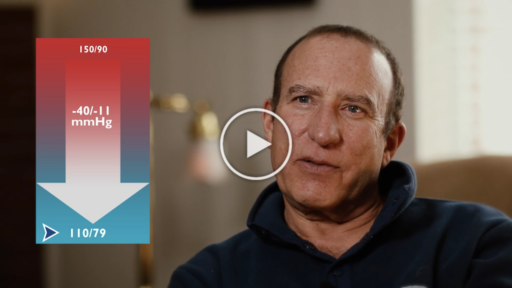
Watch How Mark Lowered His Blood Pressure Naturally.
Why Your Breathing Pattern Matters More Than You May Realize
Here is the part of this research most useful for people managing hypertension at home.
The lateral parafacial region normally activates during forced exhalation. The researchers found that in neurogenic hypertension, this region does not just fire when you cough or laugh. It runs persistently overactive.
What drives that? Oxygen sensors in your neck called the carotid bodies. These tiny cell clusters sit near your carotid artery and monitor blood oxygen levels constantly. When oxygen drops, they send signals to the brainstem to adjust breathing patterns.
The sleep apnea connection
This mechanism explains a well-documented but poorly understood link: why sleep apnea and hypertension so often go together. During apnea episodes, oxygen repeatedly drops. The carotid bodies fire. The lateral parafacial region activates. Sympathetic nerves tighten blood vessels. Blood pressure spikes.
This can happen dozens or hundreds of times per night in people with untreated sleep apnea. The effects carry into waking hours. Sleep quality is not a soft lifestyle variable. For people with high blood pressure, it is a direct cardiovascular factor.
Normal exhalation is the key
The flip side of this research is what it tells us about slow, passive exhalation. A relaxed exhale does not activate the lateral parafacial region the same way a forced one does. The lungs recoil elastically. The abdominal muscles stay quiet. The sympathetic signaling that tightens blood vessels does not receive the same trigger.
Shifting toward slow, passive, prolonged exhalation may directly reduce the neural activity keeping blood pressure elevated. That is the mechanistic reading of what this brainstem research describes.
The Emory University trials on device-guided breathing in PTSD patients, published in the American Journal of Physiology (2018), showed exactly this effect directly: a 15-minute session of guided slow breathing produced a significant drop in muscle sympathetic nerve activity. The lateral parafacial research gives us the anatomical map for why.
How Device-Guided Breathing Addresses This Mechanism
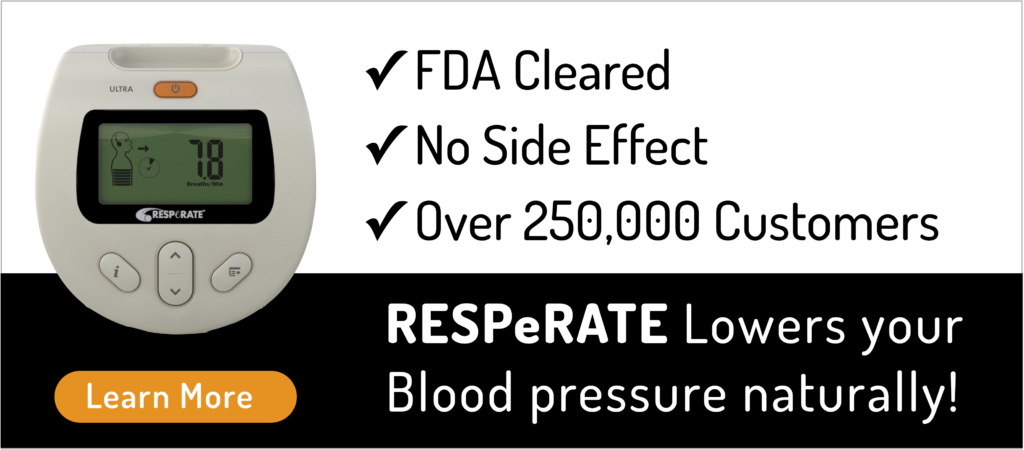
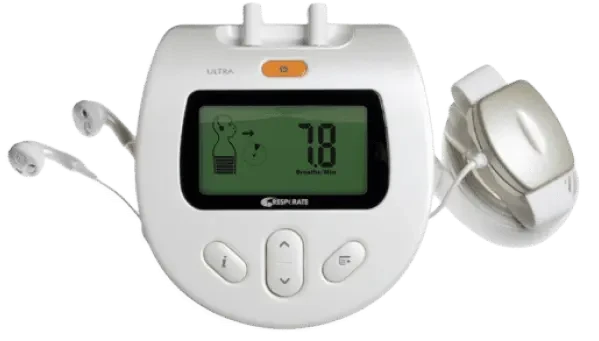
RESPeRATE is the only FDA-cleared device designed to lower blood pressure naturally. It guides users to a breathing pace of five to six breaths per minute. The device reaches that rate by gradually extending the exhalation tone.
At that pace, the exhale becomes slow, passive, and prolonged. That is the opposite of the forced abdominal breathing the University of Auckland research identifies as a driver of neurogenic hypertension.
Each session runs about 15 minutes. A sensor worn around the chest or abdomen reads your natural breathing rhythm. The device guides it downward in real time. No conscious effort is required beyond following the tones. That low cognitive load matters. Mental effort raises sympathetic activity and can undercut the benefit.
What the clinical research shows
Over 50 peer-reviewed studies back RESPeRATE’s blood pressure effects. When the exhalation extends passively, pulmonary stretch receptors send a calming signal to the brainstem. Sympathetic outflow drops. Blood vessels relax. Blood pressure falls.
The lateral parafacial research adds a new layer. It names the specific brainstem circuit that slow exhalation helps quiet. When the University of Auckland team inhibited that circuit, blood pressure fell to normal. Device-guided breathing achieves a functional version of that shift every day, at home, without medical procedures.
You can read more about the clinical evidence behind RESPeRATE on our clinical proof page.
It was 170/110, this morning it was 120/80
Watch how Julie Lowered her Blood Pressure Naturally.


What This Means If You Have High Blood Pressure
This research does not change your doctor’s guidance. Diet, exercise, sleep, stress management, and physician-directed care remain the foundation.
What it does is add scientific clarity. Lifestyle changes and breathing tools work in ways that go beyond simple relaxation. For people whose blood pressure stays elevated despite doing everything right, the neurogenic subtype may be part of the picture.
That is not a reason for despair. It is a reason to pay attention to how you breathe, how you sleep, and what you do each day to actively calm your nervous system.
Slow, guided breathing is not a wellness trend. It is a clinically studied intervention with a growing body of mechanistic research behind it. The Auckland and São Paulo work is the latest chapter in decades of cardiovascular physiology pointing the same way: the exhale is where the nervous system softens its grip.
Summary
A 2026 study in Circulation Research identified a brainstem region called the lateral parafacial nucleus that drives high blood pressure. It does this by overstimulating sympathetic nerves that constrict blood vessels. The region is linked to forced exhalation and activated by oxygen-sensing cells in the neck.
This neurogenic mechanism may account for up to 60 percent of essential hypertension cases. It also explains why slow, passive, prolonged exhalation lowers blood pressure at the neural level.
RESPeRATE is the only FDA-cleared device that delivers therapeutic slow breathing at home. Used as part of your overall health program alongside your physician-directed treatment plan, it works on the same brainstem pathway this new research has helped illuminate.
Ready to put this science to work? Explore RESPeRATE today and use it as part of your overall health program, alongside your physician-directed treatment plan.


 Clinically proven


 Eli
Eli 


